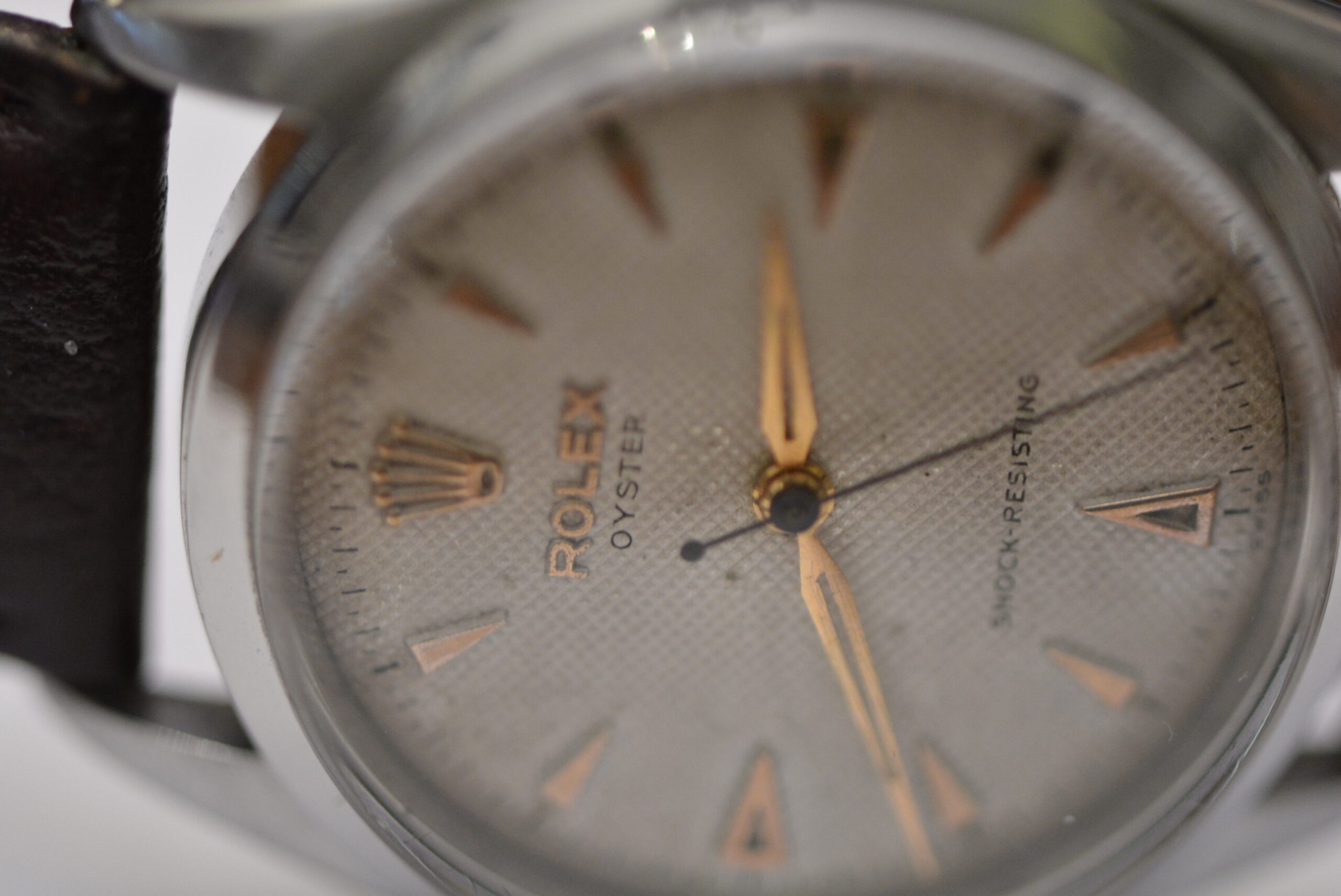
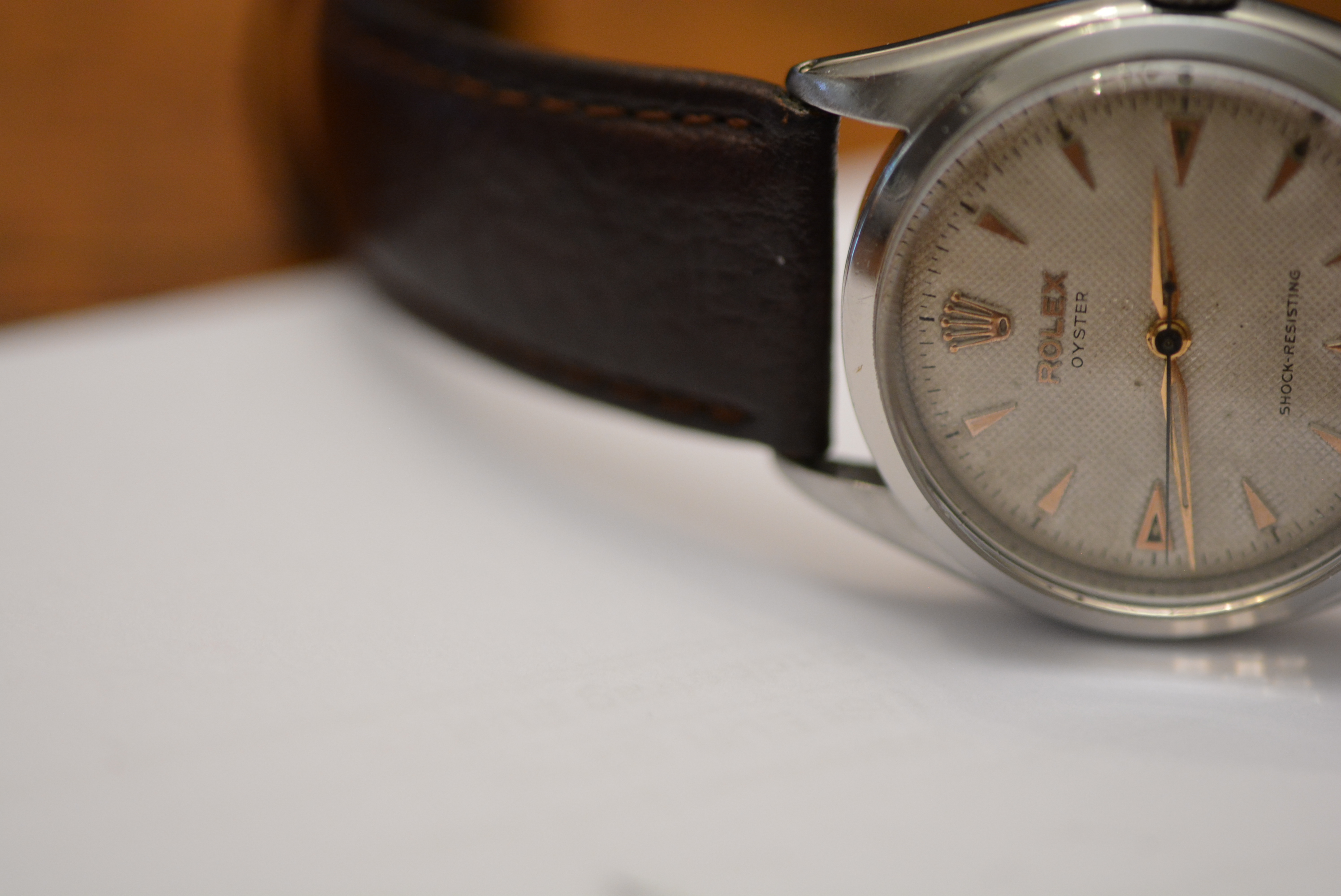
Rolex ref 6484 Honeycomb dial 1956, Steel case, white honeycomb Dial Cal. 710 Rolex Adhler Manual
The story of space adventure and their wristwatch has long been treated for the Omega Speedmaster – Moon watch. But the Rolex one has to be written yet. Unfortunately information are scarce and often in speculative posts or chat forums and blogs. If we know tons about how Omega reached its achievement – becoming a NASA’s selected time piece – we cannot say the same about Rolex. Partially because Rolex has always been stingy in sharing its history achievement, aside from the ones Rolex wanted you to know. But also because those years are obscure, with lots of trials and errors in marketed pieces. In the pure style of Hans Wilsdorf. We all know Rolex was on the path to promote itself as “the watch accompanying those reaching the mount Everest ” but little we know what really went on in the following years. Those were years in which lots of brands were experimenting in watch making but also in marketing their own name to acquire markets’ share. Surely Rolex managed to widely distribute Everest’s message – differently than the Smiths watch brand- as a tribute to the performance achievements of Rolex sturdiness facing the most challenging environment like high altitude, shock resistance and unprecedented harsh environment. That was a path towards proofing their resilience in the harshest environments on earth, and why not, above.
1953 was the year in which Rolex promoted their success in reaching, at the wrist of Sir. Edmund Hillary mountaineer, to the pick of mount Everest. If that is a fact or a constructed reality is a topic for another discussion. Yet another challenge was behind the corner, reaching space and beyond. It is likely Mr. Wilsdorf, and Rolex, wanted to reserve a front seat, quickly achieving what was unmanageable a decade before. Offering a watch that could withstand all challenges of outer space: lack of gravity, shock resistance at launch, gravity acceleration. We all know Rolex did not manage to outbid Omega performance, but we don’t know – or know really little- of what was their process to achieve it. Based on facts now clearer, a real moon watch should have been shock resistant, chronometer precise, likely manual since gravity would not count on charging the watch, most probably with some easy readability in a way to precisely track time. Those were times in which Rolex didn’t introduce yet “el primero” caliber on its offer, offering instead a more old style Valjoux 72 chronograph. My guess is that they played with what they had. The Everest peak had been just conquered, therefore features like temperature resistance and shock proofing were already at hand. The latest years Rolex had focused on oyster perpetual movement, but that was an unnecessary achievement for space. Instead a proofed shock resistance and time tracking would have been a better aim to reach, in preparation for a watch to offer to space travel personnel.
At the time of effective space travels, 1966, the watch race was already outdated. The winner had already a podium and Rolex had been definitely left behind. Only a chance was left, to produce a more commemorative piece, nowadays highly searched: the Rolex Space Dweller. A piece that recalls the color scheme of Omega Speedy – black and white – largely based on the well accepted Mount Everest achiever, the Rolex Explorer. Just a watch that practically had nothing to do with space. Surely chronometer certified, but automatic, a function made less usefull by the lack of gravity, and introducing weigh and thickness. A feature only useful in a commercial wristwatch market that would have never meet the outer space. The one who was the real racer on the challenge to acquire the podium of space were long gone, forgotten since never had a chance to become a winner compared to the highly competitive Omega Speedy. Let’s recall the first speedy in space dated 1962, informally at the wrist of the Astronaut Walter Schirra, that paved the way to the real winner of the race. We are left with pieces of a story that has never been written. A Rolex Space Dweller that had never been to space, and a Rolex Oyster Shock Resist that never made its name to the enlisted piece to run for space. My thesis is that we would like to prized something Rolex acknowledges, forgetting that in the meanwhile there were an actual space candidate for Rolex. Here you see an example that, in my account, better embodies the Rolex spirit to compete for the higher pick of the mountain, first the Everst, then the space. It has all the requirements it needs but it lacks that final pull toward the winner line. In that period Rolex had already been exclusively outsourcing its movements to Aegler, a company that in those years and the following would have developed for Rolex the Oyster Perpetual, the Oyster Date and finally the DayDate. Therefore Aegler would have been the forefront company to be chosen to ask for a sturdy movement, withstanding the challenges ahead: mountain or space that is. That is the case that in those years movements such as 710 appeared. Somehow out of place. Lonely. A manual movement agaist others “perpetual” movement, (automatic). The 710 is a super shock resist, with a Breguet hairspring, sweep seconds movement able to fit a small ebauche/case. An Oyster of 34 mm. An unadorned watch’s caliber chosen for its qualities of robustness, among others of the same period that shine for the new upgraded feature as automatic movement, indeed Perpetual.
The question of mine is: why so many automatic and then this single manual? Isn’t it because new challenges were planned ahead?
Let’s make a bit of story timeline:
1936 Aegler S.A. owned by the Aegler and Borer families give in their entire production to “Montres Rolex S.A. Geneva” with the title of exclusive Rolex movement provider, changing name to “Manufacture des Montres Rolex, Aegler Societe Anonyme” a mirror company of the Aegler family. By the 1940 it was already clear Aegler was exclusively working for Rolex production, somehow like an inhouse movement department.
1945 Rolex Datejust was first released to commemorate the company’s 40th anniversary. No “cyclope” at that time but it featured a groundbreaking movement, the caliber 710. Shock-Resist, Breguet hairspring and center sweep second. Dials with this caliber are signed with “Super-Shock-Resist”. We know a variation of it, the caliber 700 that is a sub-second. The first introduction of the Datejust was designated by the reference 4467. With the caliber 700 and 710, Rolex was equipped with a powerful and compact movement, ready to set the basis for the challenging coming decade.
1946 Omega created the Caliber 321, a chronograph movement that will fit the first Speedy in history. Developed in 1946 by Albert Piguet of Lemania – which had been acquired in 1932 by Omega’s parent company “Société Suisse pour l’Industrie Horlogère”- the movement is intended for a racer watch, surely not for space exploration.
1950 Rolex introduced the reference 6034, a chronograph collectors like to refer as Pre-Daytona with manual movement Valjoux 72, geometric indexes, 12 Arabic white dial, oyster bracelet with elastic rivet, featuring both tachymeter and telemeter scales. Produced in roughly 1600 pieces, the vast majority were cased in steel and only about 150 gold units left Rolex’s factory. The watch was commercially available in limited numbers: a watch made specifically for racers.

1952 Rolex equipped the Swiss expedition to Mount Everest, the one that came so close to reaching the peak but stopped about 1,000 meters. Possibly the reference number of these watches were 6098 and 6298 with an automatic movement, Oyster Perpetual.


1953 Rolex presumably equipped the British expedition that saw Sir Edmund Hillary and Tenzing Norgay reach the summit of Mount Everest. The expedition is supposedly using a Rolex DateJust and an Oyster Perpetual, an automatic, but also with a Smiths that will truly gain the primacy of first watch on the highest pick. The company providing the movement for Rolex is obviously Aegler, the main movement provider for the brand. These watches dressed during ascension are often addressed like a Pre-Explorer. No need to tell what these pieces are priced. A white dial watch, most likely plain white or honeycomb dial. Not marked “Explorer” but most likely “Oyster Precision” or “ Oyster Perpetual” and “ Official Certified Chronometer”. A letter published in the Horological Journal, from the head of the expedition, definitely points at watches with automatic movement: Oyster Perpetual.

The reference model above is the 6098. Unfortunately of these references many variations across years are present. It seems that between 1952 and 1962 Rolex wildly opened up possibilities and tried out different things. A bit like “keep throwing the spaghetti at the wall until something sticks”, Rolex tested many things searching what could better fit the future market. Around those years we could find notorious examples that are worth mentioning. Like the 6298 – with a size of 36 mm , sometimes called a “bubble back” within Rolex collecting circles. The convex shape of the caseback was necessary to accommodate the winding rotor of the Caliber A296 -Aegler – automatic movement inside the watch in a more modern size we found still today. Notable examples are like the pre-Explorer sold by Christie’s and belonging to Jurg Marmet, dressed in 1952 first attempt to reach the Everest peak.

1953 Rolex introduced the ref 6034, the real father of the Daytona reference 6238, in particular the second series which is called Pre-Daytona by collectors. In fact, the first series of the reference 6238 was not significantly different from the ref. 6234 but the second series made a jump introducing a more modern style adopting the baton hands, faceted hour markers and monochromatic dials (silver, black and ardoise). The telemeter scale was removed while the tachometer scale was still on the dial. The bezel was smooth and polished with a case diameter of 37 mm. The Valjoux caliber 72 chronograph movement was customized by Rolex and renamed 72 B, then 722 in the years 1965-1967.
1954 Rolex once again set the standard for luxury watches with the addition of the Cyclops lens. The dial on these watches is not yet fixed on “Datejust” that appear sporadically, often interchanged with “Rolex Oyster Perpetual” is written at 12 o’clock and “Chronometre” at 6 o’clock
1955 Rolex introduced -commercially – the Turn-O-Graph model as an award given to US Air Force pilots returning from combat missions. Likely with a caliber 1570. It is clear Rolex started to put interest in the military and aviation forces. Historically the Turnograph ref 6202 was powered by an A.260 – again Aedler – but the new version ref 6309 moved toward the movement Caliber 743 and Caliber 1065. I would call it a progressive in house production for established models, where Aegler provides movement where needed.
1955 Rolex introduced a manual-wind chronograph in an oyster case which can be considered a precursor of the Daytona. The Rolex Oyster Chronograph reference 6234 featured a tachometer scale on the outer ring and a telemeter scale for distances on the inner ring. From 1955 to 1961, Rolex produced about 2300 stainless steel pieces in a variety of black and white dials. Roughly 350 pieces per year. The three sub dials (small seconds at 9 o’clock, 30 minutes and 12 hours counters respectively at 3 and 6 o’clock) had different sizes in the various versions.


1956 Rolex is actively working with different calibers at the bay of Aegler. DayJust, DayDate and even reworkign a manual caliber, the 710. Surely after the Everest marketing campaign the Oyster Perpetual is the most known and used, as much as sold. Yet a manual movement makes its way with features that improve the shock resistance on the watch and are considered super shock resiliant. This is a time of testing, swapping, re-organizing and future planning for Rolex. The chronograph development is still on the way and not perfectioned as it should be.
1957 Omega introduces the first Speedmaster as a race chronograph – reference CK 2915 – powered by the Omega Caliber 321 movement. This movement was developed in 1946 by Albert Piguet of Lemania, which had been acquired in 1932 by Omega’s parent company, Société Suisse pour l’Industrie Horlogère. Unfortunately Rolex will introduce its best competitive chronograph only in 1963 with the reference 6239.
1958 Rolex introduced the Milgauss watch with a honeycomb dial and lightning bolt seconds hand. The scientific application takes the interest of Rolex as a marketable chance to further progress.
1959 Rolex introduces with the reference 1016 the Rolex Explorer. The watch mount an automatic movement with the characteristic black dial and 3-6-9 configuration

1962 Astronaut Walter Schirra was the first person to wear one in space during his Mercury-Atlas 8 mission. The watch is an Omega Speedmaster ref. CK2998
1962 NASA start to test watches for space explorations
1963 Rolex tests the Space-Dweller watch (a rebranded Explorer ref. 1016) in the Japanese market after the NASA goodwill tour. A likely commemorative piece since the primacy is already of someone else. Underneath the brand name and the obligatory “Oyster Perpetual” text where the “Explorer” tag usually sits is the “Space-Dweller” name. The rest of the watch, from its 36mm dimensions to its trademark 3/6/9 numerals is identical to the standard Explorer 1016. Inside the case is the time-only Caliber 1560/1570 automatic movement. A nonsense for an outer space watch.The Rolex Space-Dweller was produced in tiny numbers and sold, as a trial only, exclusively in Japan. Or that has been told many times at least. While the returning heroes of the Mercury missions had been greeted like rock stars in the country, the watch designed to capitalize on their achievements failed to land decisively with the Japanese public, and sales were muted. Since the Rolex Space-Dweller never took off, the idea was abandoned only a few years after its debut. Had the model captured the imagination in the same way as Mercury-mania clearly had, Rolex was prepared to put the rebranded Explorer into production. As it was, the Space-Dweller was retired before it even began, leaving us with one of those pieces that re-define the word “rare.” The lack of popularity may have been unfortunate for Rolex but for today’s vintage collectors, this means that the Space-Dweller is one ultra-rare model to seek out. Yet another more context base has gone totally forgotten in the process of making it to palpable markets.
1965 the Omega Speedmaster acquired the title of “ flight qualified”
1969 Speedy worn by astronauts on the Apollo 11 mission to the moon
1969 Harry Borer, son of Emile Borer, took over management of Aegler S.A. and oversaw the expansion of the company, with eventually seven new production buildings being built in the Champs-de-Boujean industrial area of Bienne. The arrangement of Aegler SA making watches for Rolex to sell continued until 31 December 2004. The Borer family decided that they wanted to sell the Aegler company, and it was bought by Rolex.
…The rest is legend…
Final thoughts:
My thesis is that if you are looking for a proper alternative to the watches that raced on the run toward the space podium, certain requirements should be better asked for. Instead of looking for a Rolex Space Dweller – that is in reality a short run of commemorative pieces copy-paste of the Explorer but that with space aims, aside color palette- has little to do.
First of all a space racer should be manual. The Speedy Moon watch is a manual chronograph, able to work in space independently from gravity. What instead an automatic would partially depend on. Second features like oyster case, shock proofing and chronometer precision should be standard. I think, based on the history of Rolex, the most likely watch we are looking for is a watch mounting a caliber 700 or 710. Both indeed were the forefront of Rolex production in the 1950 and 1960, and they are the only I know manuals that we’re currently used in Rolex ebauche that guarantee shock resistance. About the movement it is likely the best candidate would have been a really sturdy movement, like the 710 that was an evolution of the 700 in terms of shock resistance. Yet the caliber 700 would have allowed a sub-second function, better fit for track record events in seconds’ markers. A bit like doctor dial with sub second would allow doctors of those years to track pulsations. Unfortunately Rolex at that time was not forbished with chronograph companies’ suppliers readable enough to ensure shock proofing. Not till 10 years later allowing Rolex in the transition to expand their ebouche from 34 to 36 and the 40 giving space enough for a chronograph as they wished for. Therefore Rolex was in the position to choose not a chronograph. Instead the best option for them was to use a known movement with precision features. I argue that what they were after was an evolution of the 700, recalling the achievement of the 710 in terms of shock proof performance. A version that never arrived. It is not by chance that on the dial of the watches mounting the 710 often we find “super shock resist”. I guess this lack, of a sturdy chronograph, for Rolex made a difference in achieving space. There are conjectures Rolex straightforward presented to NASA a chronograph. My best guess is that they opted for a chronograph pushed by other brands that opted for that. Leaving behind the shock proofing in favor of a chronograph. It ironic the test they failed was indeed a stress test on temperatures, where hands seemed to bend under extreme temperatures. I would not be surprised a small group of Rolex chief sat around a table to pick the best candidate: in one side a shock proof movement but time only, on the other side a chronograph, what the space agency was likely asking for. The destin had been written. Moreover Rolex knew those years were to focus on space exploration models, re-addressing their purpose to science (Milgauss), adventure(Explorer) , elegance (DateJust and DayDate) markets. Why don’t invest in something at hand with better potentials? Better fit for their current capacity. Maybe just deciding on capitalizing on the space boomerang effect of the space race with a short run of repurposed Explorer , rebranded as Space Dwellers. The race was already on the way and there was no time to develop from scratch a better sturdy chronograph. Surely they did participate in the space race, but already knowing they were inferior to competitors, focusing instead on ready available commercial markets. Nonetheless Omega reached space by chance, just repurposing and improving an already strong race watch, this time for space.
But let’s keep moving to identify the Rolex could have made it in the space race to the pre-daytona. Given the history of Rolex on Everest and the subsequent success and development in terms of the proposed commercial model, I could assume Rolex would have participated in the race to space with an easily readable dial. Simple set of markers probably would have been chosen, with an emphasis to dial orientation, in a way to capture the directionality of the watch in space. It was unlikely a 369 dial since such a model in military application never found a place. Most likely arrow pointer markers enlarged at 369 position with a special sign, visible and reflective at the top of the dial. A crown maybe? If we look at the aeronautical proposed model most commons were white or pail dials, non reflective. In many application black dials were for marine or land applications. While aeronautics were more light non reflective colors. I would suggest therefore that Rolex, for a space watch, would have opted for a white dial, honeycomb because it allows deepness of the dial for easy readability without being purely reflective as a surface. Gilt markers could have been preferred to capture light where little light is available in space. The model it follows could have been the one- With the difference it would have a sub-second dial at 6, likely larger with a thin seconds rail to better distinguish the intervals of time. Here we have: two candidates. One it is known, a pre-daytona that lost the race. The other, an Oyster Super Shock Resist Sub Second, totally forgotten. History will write the destiny of both: one to be forgotten – the oyster shockproof. The other to be a later success in everything else than space – the Daytona sport racing model. We would have wished to be there.
You want to look for something interesting. With all you have read till now I think these models, the 6098, deserve a bit more respect, at least compare to their half-brothers Space Dweller.
Side Note – Rolex Wish List.
Wouldn’t be nice if Rolex once in a while, instead of doing something for “fun”, with little appreciation from the community, would play a Story Card. We know Swatch Group did it by introducing the watch series “What if”. In 1982 Swatch’s founders opted as a launch model for a round shape, posing themselves a question: What shape will our first watch have? Last year they launched a new series “What if” based on the hypothesis “what if Swatch choosed a square instead of round. An interesting concept that dives into the past of the brand, and refresh a simple concept: design is about gut sometimes, but it is never too late to change it. Based on the same principle I think it would be interesting to see Rolex launching a mechanical manual winding sport model, an oyster, playing around the concept that such model was the option B facing the moon race to space. Not a reiteration of a rolex explorer, but a real option, different dial and hand finishing, and why not, blurring the line between past and present: once again sport does not mean less elegant.
sonablate
Helpful info. Lucky me I found your website unintentionally, and I am stunned why this accident did not came
about in advance! I bookmarked it.